Yes Pelosi Its Time to Make America White Again

Nancy Pelosi Doesn't Care What You Call back of Her. And She Isn't Going Anywhere
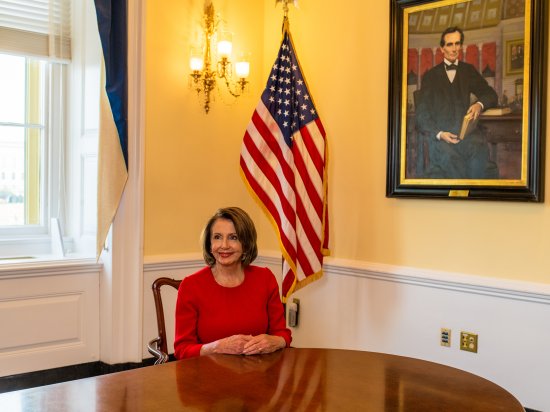
Loathed by the right, nether fire from the left. Nancy Pelosi says she isn't going anywhere
Nancy Pelosi stopped caring almost what people think of her a long time ago, so she has no qualms about eating ice cream for breakfast with a stranger. Nighttime chocolate, ii scoops, waffle cone. It'due south a freezing Jan morning time in Baltimore'south Little Italia, where Pelosi grew upwardly in the 1950s. "You know what'south good about water ice cream in this weather?" she says. "It doesn't cook downward your arm while you lot're eating information technology."
We are sitting in an Italian café on Albemarle Street, alone save for the staff and Pelosi's security detail, to whom she has offered coffee. The Trump era has many Democrats in a panic, merely Pelosi inhabits a more cheerful reality. She is convinced that America has hit bottom, has seen the error of its ways and is ready to put her back in charge.
The 78-year-old quondam House Speaker knows what her critics say nigh her: that she's too old, too "toxic," too polarizing; that after three decades in Congress and xv years leading her party's caucus, she has had her turn and needs to become out of the fashion. Only there's a reason she sticks around. Had Hillary Clinton won the 2016 election, she says, "we'd have a woman at the head of the table." When that didn't happen, Pelosi realized that without her, in that location might non be a woman in the room at all.
Pelosi is 1 of the nearly consequential political figures of her generation. It was her creativity, stamina and willpower that collection the defining Democratic accomplishments of the past decade, from universal access to health coverage to saving the U.S. economic system from collapse, from reforming Wall Street to allowing gay people to serve openly in the military. Her Republican successors' ineptitude has thrown her skills into abrupt relief. It's non a stretch to say Pelosi is one of very few legislators in Washington who actually know what they're doing.
Just few people talk about her in those terms. Instead, Pelosi is regarded every bit a political liability. Republicans encounter her every bit their biggest asset, and promise to motivate their voters in the midterm elections by putting her image in television set ads. Meanwhile, despite the hundreds of millions of dollars she has raised for her party, virtually 60 Democratic House candidates accept returned the favor by calling for new leadership. Alexandria Ocasio-Cortez'due south June 26 primary upset of one of Pelosi's lieutenants, Representative Joe Crowley of New York, highlighted the restlessness of the party's grassroots, and Pelosi'south erstwhile allies in the Congressional Black Conclave accept pushed Representative James Clyburn to challenge her. Even the New York Times editorialized that she should go.

None of this fazes Pelosi. "If I weren't effective, I wouldn't be a target," she says, working on her ice foam every bit leftover Christmas songs play in the groundwork. The just role that bothers her, she says, is when women who are thinking of running for part tell her they couldn't withstand the abuse. "I say, 'Forget what they're doing to me, considering you won't be that much of a target. But you volition be a target, because this is about power. And if you look similar you lot're making headway they will come later you. And it won't be a pretty sight.'"
The attacks on Pelosi are especially ironic in this political moment. Since Donald Trump's election, American women have poured into the streets, signed up to run for function in record numbers and surged to the polls. Many of them look a lot like Pelosi once did. They are brainy, liberal and comfortably situated moms who take looked at the political system with the exasperation of a person who has seen her hubby get the laundry incorrect and realized that she'south going to take to do it herself. If Democrats regain congressional power in November, as most experts await, it will exist by riding a tidal moving ridge of female person rage. But rather than tout their female person leader–the first woman Speaker in history, and the odds-on favorite to reclaim the championship–many Democratic politicians, both male and female, are running in the opposite management. In this flavour of female political empowerment, Pelosi's power still rankles.
Information technology seems to enrage people that Pelosi feels entitled to things: coin, power, respect. Of class it does–a adult female is e'er held responsible for her reputation. Clinton, in her years running for President, was asked over and over again some version of the question, Why practice you lot think people don't like you lot? (Despite not being on whatsoever ballot, Clinton, besides, figures prominently in the Republicans' fall campaign strategy.) A powerful woman is always divers less by what she has done than past how she makes people feel.
Pelosi isn't humble. Many women, she thinks, are afraid to bear witness pride and need to see an instance of conviction. Besides, making sure you get your due isn't something you can consul. One former Pelosi aide told me everything she does is rooted in this combination of obligation and entitlement: the sense that someone ought to do something, and she is the just 1 who can do information technology. Pelosi seems to experience no need to repent for her status in the style women are expected to and men rarely are. Maybe the assertion of ego by a woman is the almost radical act there is: the refusal to submit or be subordinate.
It is not in Pelosi's nature to cower or grovel. She will be who she is–liberal, privileged, unpopular–and let the chips fall where they may. To some Democrats, Pelosi's is an attitude of unconscionable selfishness: she's willing to damage her political party to hold on to the position she believes she deserves. The story of Nancy Pelosi is, inevitably, the story of what people think of her. The way she is recognized and remembered, the way she is held to account. And and then Pelosi doesn't have the luxury of not caring about what people recollect of her: it'due south the question on which her hereafter, and the future of American politics, depends.

The forenoon afterward the biggest main upset of 2018, Pelosi placed a call to Ocasio-Cortez. The 28-yr-old socialist from the Bronx had predicated her entrada against the House's fourth most powerful Democrat on getting rid of the erstwhile, out-of-touch party establishment, and pundits were speculating nigh the implications for other longtime leaders. Sitting on a goldenrod-colored sofa in her blusterous office on the second floor of the Capitol, Pelosi picked up the telephone and set to the job of holding her fractious party together.
She told Ocasio-Cortez that while she loved Crowley, she had always wanted to see more than young, progressive women in Congress, according to a person with direct noesis of the conversation. "There'due south a lot to exercise," Pelosi told her. "Cheers for your backbone to run. This is not for the faint of middle." It was typical Pelosi–a compliment, wrapped in an invitation to join the team, with merely a hint of potential consequences. And it reflected a political teaching that, for Pelosi, began a lifetime ago.
The youngest of seven children and the only girl, Pelosi grew upwards similar royalty. Her father Thomas D'Alesandro Jr. was a member of Congress when she was born, in 1940, and the mayor of Baltimore by the time she was 7. When young Nancy wasn't beingness ferried to a Catholic girls' schoolhouse, she was attending her father'south ceremonial events or helping him become out the vote. Her male parent'southward ancestors had immigrated from Genoa, Venice and Abruzzo, her mother'southward from the southern Italian city of Campobasso. The family unit lived in a 3-story brick row business firm in the centre of Little Italy, a blue collar community near Baltimore's industrial waterfront. The house appears vacant now; Pelosi points it out to me every bit we drive by. (We had planned to take a walking tour, but it's a common cold day, and she detests the cold.) A few blocks over, there are hipster restaurants and lofts, just in this office of town, the corners still feature traditional pasta houses.
D'Alesandro wore a bow tie and straw boater and helmed an quondam-school urban Autonomous machine, with party bosses pledging the loyalty of their tribes: the Italians, the Irish gaelic, the Jews, the blacks. His politics were nearly favor-trading and patronage, not grand ideological designs. (His aspirations to become governor were thwarted by a corruption scandal involving parking-garage structure, co-ordinate to a 1954 Time report.) Pelosi has a strong sense of ethnic identity–she credits her Italian heritage for her stamina–and as a leader she approaches the factions of the Democrats in a similar party-boss style. As her friend the tardily Congressman John Murtha used to say, "Don't call up she's from San Francisco. She'south from Baltimore."
Pelosi's family made her a Democrat, but it was the 1960s that made her a liberal. While at Trinity College, a Catholic women'southward school in D.C. at present known as Trinity Washington University, she attended John F. Kennedy's Inauguration and was swept off her feet. "Forget motion-picture show stars. Nosotros were all in love with JFK," recalls Pelosi'south college friend Rita Meyer, one of a tight group of iv girlfriends who remain close today. Her worldview still resembles JFK's brand of liberalism: Catholic social justice, with a bear upon of noblesse oblige.
She embarked on the life of a traditional wife and mother. It was 1963, the year The Feminine Mystique was published, and the idea that women would graduate from college and start careers hadn't taken concord. She had watched her own mother'due south ambitions stifled by a domineering spouse. Now Pelosi followed her husband, financier Paul Pelosi, to New York Metropolis and then to San Francisco, giving birth to 5 children in rapid succession.
Her life changed in 1975, with a phone call one afternoon from then San Francisco Mayor Joseph Alioto. "Nancy, what are you lot doing? Making a big pot of pasta?" she recalls him proverb. (Pelosi is not much of a melt.) He offered her a spot on the city'southward library commission and insisted that she take it. "I said, 'I'chiliad interested in the library, but I don't need an appointment to the commission,'" she recalls. "And he said, 'You shouldn't say that. You're doing the work; you should receive official recognition for it.'" That was a feminist lesson that stuck with her–a woman should get the credit she deserved–fifty-fifty if it was amusingly dissonant with the mayor'southward assumption that she spent her days slaving over a stove.
Pelosi became active in California politics, raising money for candidates. She went on to chair the California Democratic Party and took a atomic number 82 part in organizing the 1984 Democratic National Convention. She discovered a talent for assuaging the egos of powerful men even as she stood her ground against them. Notwithstanding she all the same envisioned herself as a helpmeet, a backside-the-scenes actor. Then, in 1987, the San Francisco Congresswoman Sala Burton, who was dying of colon cancer, called Pelosi to her bedside and made her promise to run for the seat. When Burton died, Pelosi moved into an elegant firm in the posh finish of the commune and entered a fractious fourteen-way Democratic principal.
Pelosi positioned herself equally a well-connected pragmatist, with the slogan "A vox that will be heard." She spent more than $1 meg, a staggering sum at the time and more the residuum of the field combined. Her campaign targeted the district's wealthy residents with flyers that promised she would fight income-tax hikes. It was likely Republican voters who carried her to victory, according to Marc Sandalow's biography Madam Speaker.
The district was the centre of the urban center's gay community. Pelosi became its champion, fighting for everything from health insurance and housing subsidies to the AIDS quilt, a football game-field-size memorial she convinced the National Park Service to let on the Mall. She co-authored the bipartisan 1990 Ryan White Act, federally funding the treatment of low-income AIDS patients, which she muscled onto the national agenda and got a Republican President to sign. She was a supporter of gay marriage at a fourth dimension when her political party was pushing the Defence force of Marriage Human action. In 1993, she read a letter from Neb Clinton at an AIDS rally that the President declined to attend in person. When detractors sneer at her "San Francisco values," she hears a homophobic canis familiaris whistle.
Every bit Pelosi saw it, she was sent to Washington to stick upwardly for her constituents. "She knew people personally who were dying by the week," says James Hormel, a co-founder of the Man Rights Campaign and an early Pelosi supporter. "The people in her district don't come across her as somebody whose time has passed. They run across her as a very vigorous defender of their rights."
In these days of gridlock, most members of Congress showroom a sort of learned helplessness, waiting for someone else to come up with an idea so that they tin come out against it. It is especially bracing, in this environment, to relive some of Pelosi'due south early crusades. She may not have set out for Congress, but once she got there, she attacked it with urgency–and ofttimes won.
As a inferior fellow member, she spent five years fine-tuning a complicated programme to preserve San Francisco's verdant Presidio by converting it from a war machine installation to a public-private partnership with the National Park Service. Her own party put the legislation aside, but Pelosi kept at it, enlisting Republican allies, lobbying fellow members and offer policy concessions. In 1995, she managed to get a Republican Congress to create the nation's most expensive national park–in the middle of San Francisco. As i Republican, James Hansen of Utah, marveled at the time, "At that place is no question she is a very persistent legislator."
Pelosi claimed to have no interest in a leadership position. But when, in 1997, the but Californian among the Autonomous contumely stepped downwardly, she saw her moment and began jockeying, calling in favors from her years of fundraising. "She raised the f-cking dough," explained her friend and mentor, old Congressman John Burton of California. "She ought to be able to get something for it."
It took four years for the role Pelosi wanted, Democratic whip, to open upward. She spent the whole time running a hard-fought race against Representative Steny Hoyer of Maryland, who had known Pelosi since her college days. Pelosi was accused of threatening to punish an unsupportive colleague past getting her district redrawn. Hoyer somewhen became Pelosi's No. ii and a committed frenemy–a situation House Democrats describe as a long-running cold war.
During the George W. Bush years, Pelosi was a vociferous critic. She was the about prominent Democrat to oppose the war in Republic of iraq from the start, believing the intelligence wasn't solid. In 2006, buoyed by an electorate that had come around to Pelosi'south antiwar position, the Democrats won the House, and Pelosi became America'south start female Speaker.
So, at the acme of the 2008 entrada, the economy collapsed. On the afternoon of Sept. 18, Pelosi called Treasury Secretarial assistant Henry Paulson and suggested they meet with congressional leaders the next day. But Paulson said it couldn't look that long. That evening, the Republican and Autonomous leaders of the Firm and Senate met in Pelosi's conference room with Paulson, Federal Reserve Chairman Ben Bernanke, Securities and Exchange Committee chairman Chris Cox and White House representatives.
In that location were just half dozen weeks until the election, and information technology was clear that the bailout Bernanke and Paulson were asking for would be extremely unpopular. Firm Republican leader John Boehner couldn't deliver the 100 votes he had promised. And so Pelosi went back to her people and begged for more support. "She had to go to the Democratic conclave and convince them to give a $700 billion bailout to the most unpopular homo beings on the face of the globe, then go home and face their constituents who were losing their homes," says John Lawrence, Pelosi'southward chief of staff at the time. The bailout passed the House with the back up of 172 Democrats and 91 Republicans.
In this and other legislative jams, Pelosi's strategy was persistence, persuasion and an encyclopedic knowledge of her caucus: what they wanted and what they feared. The nighttime before a big vote, she and her staff would pore over the list of uncommitted members, figuring out who could be swayed and how. "Invariably, she'd go to the bottom of the listing and become back to the superlative and offset over," says Lawrence, "which was not very highly-seasoned at 2 a.m."
When Barack Obama won in 2008, Democrats had their chance to put roughly a decade's worth of pent-up ideas into practice. They enacted fair pay for women, college aid and the stimulus, which included a raft of anti-poverty efforts. Pelosi's House passed other priorities that died in the Senate, including a union-boosting mensurate and climate legislation. Her unruly caucus spanned the ideological spectrum, from Blue Dog conservatives to far-left ideologues, merely Pelosi never lost a major vote. "I was in those rooms when people were saying, 'Permit's just throw in the towel,' and she'd say, 'Give me the names and leave me alone for a minute,'" says George Miller, a retired California Congressman.
The crowning achievement of Pelosi'south career was health intendance reform. Democratic Presidents had been pursuing universal health intendance since the New Deal. Pelosi helped arts and crafts the House version of the Affordable Care Act. The trickiest part was balancing regional interests, particularly in setting Medicare and Medicaid reimbursement rates, which vary by jurisdiction. At one point, Pelosi and others call up, an aide told her there were 67 members who hadn't committed to vote for the bill and asked how they should split up upwardly the work of persuading them. "Give me the list," Pelosi said, and she made calls through the night.
Pelosi besides knew when people didn't want to hear from her and could find other buttons to push. To win the vote of Joe Donnelly, a conservative Indiana Democrat who is now in the Senate, she got the former president of Notre Dame to appeal to his Catholic conscience. Zack Space, a Greek-American former Congressman from Ohio, started getting calls from the Greek-American donor community when Pelosi wanted to apply pressure on a different mensurate. "She could hear frequencies from the caucus that weren't audible to others," says onetime New York Congressman Steve Israel.
In January 2010, Democrats lost the Massachusetts Senate seat vacated by the death of Ted Kennedy, depriving them of their crucial 60th vote to surmount a filibuster. Sensing that the party was losing the politics of the health intendance debate, White House chief of staff Rahm Emanuel circulated a plan to pull dorsum, passing only a children's health intendance measure and moving on from the effect. At a meeting in the Oval Office, Pelosi confronted Obama. "Mr. President, I know there are some on your staff who want to take the namby-pamby arroyo," she said, according to two people who were in the room. "That's unacceptable." Obama took Pelosi's side, and Emanuel'south programme died.
Obama's relationship with Pelosi was his closest one on Capitol Hill, a one-time Obama aide tells me. "More than anyone else in the United States Congress, House or Senate, Democrat or Republican," says the Obama aide, "she always kept her word to him, and she ever delivered." (The favor wasn't necessarily repaid: Obama refused to appear at a Pelosi campaign event during his 2012 re-ballot entrada, according to a source familiar with the episode.)
The halcyon days of liberal legislating were short. In 2010, Republicans took back the Business firm, riding a moving ridge of voter anger at Obama, the Wall Street bailouts and health care reform. Pelosi was expected to resign in defeat, but she refused. In that location was only one way she would be vindicated: winning the majority again. And she was willing to expect.

If it'south Friday, this must exist Houston. Pelosi has raised $680 1000000 for her political party since 2002, and on this February evening she is clicking her way across the basement floor of the convention-center hotel where the local Democratic Political party is belongings a fundraising dinner. It'south one of 71 events she'll nourish in a 3-calendar month span. In public, she tries to mention Trump as lilliputian as possible, just every bit she speed-walks through the hotel she tin can't help herself. "I just can't get over this President," she says. "He is and so beneath the dignity of the function, with everything that he says. Information technology's just amazing to me!"
The people at the exclusive predinner reception accept all paid to run into Pelosi, but that doesn't mean they all admire her. "She is a strong leader," says Sergio Lira, a local school-lath official. "Simply honestly, I call up mayhap it's time for a alter in leadership. She'south been there a long time." Democrats, he says, need leaders who tin can galvanize and rally the base. "Nothing confronting her," he says, "but I think her best years are behind her."
Information technology is the Harris County Democratic Party's largest almanac dinner in history, a testament to the energy on the left this year. Pelosi sits at a table with her longtime friend, the Autonomous megadonor Amber Mostyn, under a giant chandelier. Onstage is Texas Congresswoman Sheila Jackson Lee, a notorious stage pig who one time complained that hurricane names are racist. To Pelosi'south surprise–she hates beingness surprised–Jackson Lee has Hillary Clinton on her phone, which she holds up to the mic, causing booming echoes. Clinton, reading woodenly, acknowledges "the presence of our nifty Democratic leader, Nancy Pelosi," so reads a confusing tribute to a dead woman who has not been honored on the program. (Pelosi's relationship with Clinton is cordial only distant, aides to both say.)
Finally, virtually three hours in, Pelosi takes the phase. Friends say she has improved equally a public speaker, but she'due south nevertheless uninspiring, reading laundry lists of policies, reciting shopworn slogans and trotting out the aforementioned quotations over and over. "Some people have an unlimited tolerance for the suffering of others," she says at i point. "And we're like, 'What? That's not the way it'due south supposed to exist.'"
Republicans would similar the 2018 election to be about Pelosi. "Nancy Pelosi is a theme that works anywhere in the land. It's very motivating," says Corry Elation, who is in charge of the Firm Republicans' super PAC, speaking as if Pelosi were a policy proposal. People have a "visceral" reaction to her, he tells me. "We will spend tens of millions of dollars reminding people across the country of what she would exercise every bit Speaker."
A Pennsylvania House special election in March foreshadowed this approach. Well-nigh 60% of the GOP's ads consisted of attacks on Pelosi, while 7% of the Democrat'southward ads featured the candidate assuring voters he didn't back up her, according to the Wesleyan Media Project. The Democrat, Conor Lamb, won anyway. "If all we've got is Nancy Pelosi," a Republican strategist told me, "nosotros're pretty drastic. It's not going to be plenty."
What Pelosi would like the ballot to be about is neither her nor Trump but the taxation legislation that the Republican Congress passed in December, which she has dubbed the "GOP revenue enhancement scam." Calling it a handout for the wealthy, she has derided its benefits to the center class as mere "crumbs," a comment for which Republicans pilloried her. Just Pelosi thinks she's winning the argument. In their midterm campaigns, Republicans have largely stopped touting the revenue enhancement bill, as the message didn't seem to exist resonating.
Pelosi may have a rare talent for legislating, but her entrada skills are questionable. Every bit proof of her acumen, she's still telling the story of the 2000 elections, when she helped her party pick up five House seats in California even as Democrats lost races across the country. She takes credit when her party wins, but blames others when Democrats lose. Her message this year, that Republicans are for the rich, is essentially the aforementioned one Democrats accept used in every recent ballot, with a couple of new slogans attached–even thought the President is far from a normal Republican. "The leadership is notwithstanding in this 1990s mind-ready," a former member tells me.
The morning time after the dinner in Houston, Pelosi travels to a teachers'-matrimony hall for a discussion on the tax constabulary. She sits in a folding chair at the front of the room, enduring another endless preaching-to-the-choir event. One person asks her what Democrats tin do about people "voting against their best interests," and Pelosi speaks carefully, not wanting to be baited into a "basket of deplorables" moment.
Trump voters, she says, demand compassion, not condescension. "I don't want to be disrespectful of any of the people who voted for the President," she says. "I do want to make sure they understand what he is doing to them." It may take patience, she adds. "Did y'all ever know anybody who was dating a jerk?" she asks. "Could you tell her? No. You take to wait until she figures it out for herself–hopefully earlier information technology'south too late–or you'll only drive her into his arms."
Later, Pelosi mingles with the crowd. A woman has brought a volume to exist signed for her daughter. "You're an inspiration," she says. A human volunteers advice: "Put President Trump on the spot!" he says. "Offer to debate him!" The women have gratitude; the men have demands. The women respect her; the men desire to tell her what to do. She smiles graciously and poses for some other pic.
For someone like Pelosi, who has spent her life in service of institutions–indeed, for anyone who has spent their life following a set of agreed-upon rules–the Trump era has been destabilizing. But Pelosi evinces an odd equanimity. Not wanting to get Trump'southward foil, she lambastes him far less than she did Bush. "Being surprised, disappointed, even wondering about his beliefs is a luxury we can't afford," she tells me over dinner at a Houston resort. It's another one of her tiny nonmeals: she'll eat only a basin of seafood chowder and a drinking glass of water, and spend nearly 3 hours talking. "I tin't waste my time thinking, Why would he say that? Why would anybody support somebody who says that?" she says. "It doesn't matter anymore. All we take to do is win this election so that nosotros can have leverage for the American people."
In the meantime, Pelosi has used her scant power in Congress to considerable effect. Despite controlling all iii branches of government, Republicans take proved unable to enact almost of their promises, including their signature vow to repeal Obamacare. Pelosi and her Senate analogue, Chuck Schumer, take repeatedly outmaneuvered the President. In September 2017, they got Trump to agree to a spending deal that raised the debt ceiling and funded the government, drawing howls from conservatives. In March they cut another spending deal, this one and so favorable to Democrats that Trump blasted information technology fifty-fifty as he signed information technology.
No detail in that nib escaped Pelosi'southward attending. At 1 point, to resolve an impasse over pocket-size-league baseball salaries, she worked out a compromise with the league through her human relationship with the president of the San Francisco Giants, securing the players a pay increment. The final pecker lifted spending caps and additional domestic appropriations by some $sixty billion, while blocking Republican efforts at environmental, labor and banking deregulation. "We wouldn't have been able to pass that spending package nether Barack Obama," a House Democratic staffer told me. "Republicans would have laughed united states of america out of the room." The real art of the deal in Washington is beingness good by Pelosi, in what ought to exist the Capitol's least powerful caucus.
Pelosi'south talents aren't always enough. Final yr, the President told her and Schumer he wanted to protect immature undocumented immigrants, known as Dreamers. But he soon retreated to a hard-line position. A January government shutdown over the effect ended later two days, when Senate Democrats panicked and caved. In February, Pelosi made a last stand up, taking to the floor of the House for eight hours to read the stories of young immigrants. It was a political stunt designed to draw attention away from the fact that Democrats had failed the Dreamers.
The post-obit month, Pelosi called Trump in a last-ditch endeavor to work out a solution. He greeted her past noting that he had recently run across her son in Palm Beach, Fla. Pelosi steered the conversation to immigration, urging him to support bipartisan legislation pairing a Dreamer gear up with edge-security measures. Trump, noncommittal, suggested they accept lunch instead. Pelosi ended that she was wasting her time and turned him down.
Trump blasts Pelosi in public, but in individual he treats her with a sometimes awkward solicitousness. At one White House meeting, Pelosi casually said that the group assembled should "pray for success" on immigration, co-ordinate to an adjutant briefed on the meeting. "Are you lot going to pray?" Trump asked her. She ignored him and kept talking, just to have him repeatedly implore her to "exercise a prayer." Seeing that she did not intend to conduct one, Trump finally got Vice President Mike Pence to exercise it instead.
Thanks in large part to Trump's unpopularity, a improvement is in sight for the Democrats. As many equally 91 Republican-held seats may exist vulnerable in November, and almost nonpartisan handicappers think Democrats are favored to gain the 23 seats they need to retake the House. That would make Pelosi the Speaker again–if a majority of Democrats support her.
She insists that they do, simply her concur on the caucus has clearly diminished. In 2016, 63 House Democrats–nearly one-tertiary–voted confronting her for leader. No one argued that Pelosi's challenger, Ohio Representative Tim Ryan, could manage the caucus better, negotiate meliorate deals with Trump or better shepherd complicated legislation through the fractious and unruly House. They just wanted change.
Since then, the malaise has just grown. Crowley's defeat inspired more infighting, with younger members such every bit Representative Seth Moulton of Massachusetts agitating for her ouster. Ocasio-Cortez, who hasn't said whether she would support Pelosi, epitomizes the young, various, far-left grassroots Democrats who find Pelosi frustrating. In June, after Congresswoman Maxine Waters urged supporters to publicly confront members of the Trump Assistants, Pelosi rebuked her, tweeting, "Trump's daily lack of civility has provoked responses that are predictable only unacceptable." The base erupted. The old, white establishment of the Democratic Party "just isn't where the base is on how big a threat white supremacy is to the country," says Sean McElwee, co-founder of Information for Progress, "vs. how big a threat existence mean to Trump is."
Despite the frustrations, Pelosi persists. No one I spoke to expects she will lose a Speaker vote if Democrats accept the House by a big margin. If they lose or win a slim majority, it could be a different story. Her grip on her caucus is principally due to her legislative skills and the favors she has accrued. But information technology's also because there's no obvious successor. Over the years, Pelosi has frozen out, stymied or simply outlasted younger members who seemed to pose threats, most of whom–Chris Van Hollen, Xavier Becerra, Israel–accept given upwards and left the Firm. Crowley's loss removed some other potential threat, while also creating a vacancy in leadership. A competition for that position would take some heat off Pelosi. Just the threat is real: under pressure level from members, Pelosi in mid-July pushed back the party'southward mail-election leadership vote until after Thanksgiving.
The idea that she'due south a liability peeves Pelosi and her staff, who argue Republican congressional leaders are just as unpopular, if not more so. In a June Gallup poll, Pelosi's approval rating was 29%, while outgoing Speaker Paul Ryan's was 40%, Schumer's was 29%, and Republican Senate leader Mitch McConnell's was 24%. "I call up I accept my pluses and my minuses," Pelosi tells me. "But I have a conviction about what I bring to the table in terms of my network of friends effectually the land. And I get things done, even with a Republican President."
Pelosi has been reading near the technicalities of impeachment, just she thinks information technology's a political loser now. "I have my judgment about this President," she says. "Simply the American people are non going to have an impeachment if in that location isn't solid, conclusive evidence presented in a nonpolitical way." Some of her colleagues, I reply, believe that evidence already exists. "We'll see what Mr. Mueller discovers," she says. "It remains to be seen."
Information technology'due south now night outside and I'm exhausted, having met Pelosi later her forenoon walk and 8 a.m. pilus date, taken half as many meetings and worn substantially more comfortable shoes. Later this, I'll get to bed, but Pelosi volition take advantage of the time difference to brand several hours of calls to the W Coast. An aide refers to her stride as "kill-the-staff speed."
Thinking back to our chat in Baltimore, I enquire Pelosi if men aren't right to feel threatened by the rise of women. Afterward all, there's simply so much power to get around. She disagrees, insisting information technology'southward non a zero-sum game. But isn't there only one Speaker of the House? "That'south but one job," she says. "There are other jobs."
In one case, while she was Speaker, Pelosi traveled to Afghanistan via State of kuwait. The Kuwaitis treated her with elaborate deference, calling her "Your Excellency." Every bit the military aeroplane soared over snow-capped peaks, Pelosi heard the pilot say he was headed for Kabul. That's wrong, she said. You lot're supposed to be taking me to Bagram Airfield to come across the troops. Merely the pilot wouldn't take her word for it. He called the U.Due south. embassy in Pakistan. She could hear him on the radio: "Our instructions say to become to Kabul, only payload wants to go to Bagram." Pelosi cracks upwardly at the memory: "In a few hours, I went from 'excellency' to 'payload'!"
She leaves the real punch line unspoken. It didn't matter what they chosen her. In the end, they did what she wanted.
Source: https://time.com/magazine/us/5388333/september-17th-2018-vol-192-no-11-u-s/
0 Response to "Yes Pelosi Its Time to Make America White Again"
Post a Comment