Can a Single Man Adopt a Girl Child
As transracial adoption becomes more than common, hither's what every parent should know
Karen Valby is a writer who lives in Austin, Texas. She and her husband, who are white, have two adopted daughters, one Ethiopian and 1 African- American.
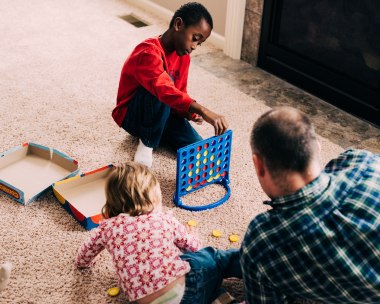
Robyn Wells believed she went into the adoption of her Ethiopian son with optics wide open up. She and her married man Timothy, a police officer and Army veteran, who served 2 tours in Iraq and one in Afghanistan, brought Ben domicile when he was four years one-time. The Wells are white and live in Champaign, Illinois, a multi-cultural Big 10 university boondocks and have gone to some effort to create a diverse surroundings for their son and three biological daughters. Wells knew that raising a blackness son wouldn't e'er exist piece of cake. "I figured I'd have to explain some name-calling, have hard talks about linguistic communication, navigate the waters when somebody'south parent won't let my son take their daughter to prom," she says. "But what I have been surprised by is this: At no indicate in the process of considering transracial adoption did I think I would have to teach my son how to stay alive."
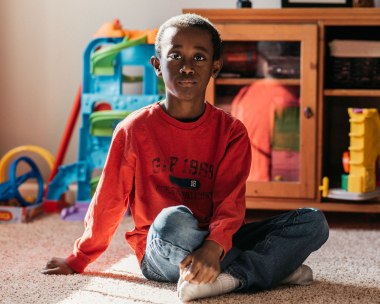
First, she says of her enkindling, there was the shooting of Trayvon Martin in 2012. At the time Ben was a 6-year-old boy who had just learned to ride his bike afterwards but ii trips upwards and down the driveway with his father running alongside him. "Information technology was awful," says Wells, "simply I thought—equally every white privileged parent wants to think—peradventure this is an isolated incident." As events quickly proved, information technology was not.
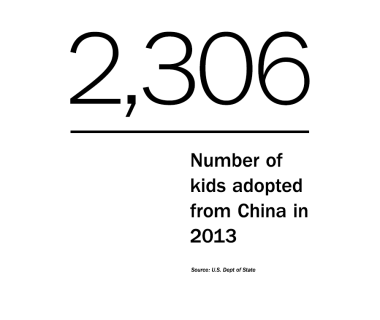
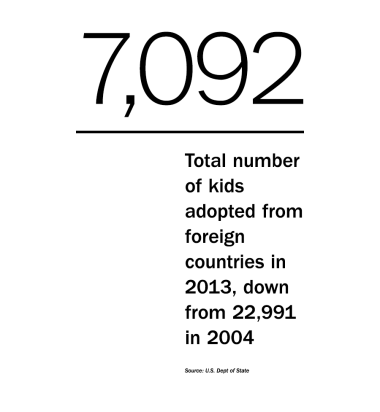
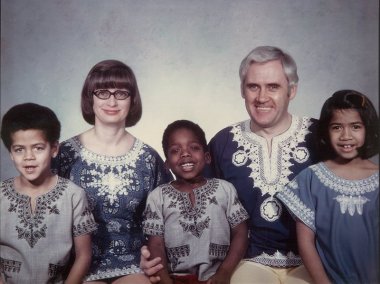
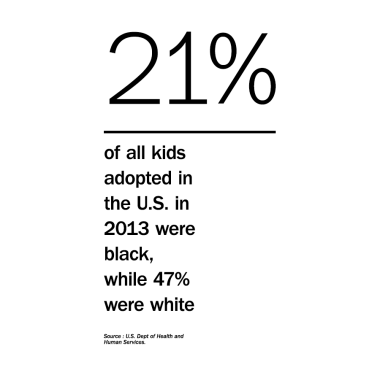
Many families struggle with the question Wells is facing: how do white adoptive parents help their children of color thrive? Today, more than 40% of adoptions are transracial in nature co-ordinate to a recent survey from the Department of Health and Homo Services. This is up from 28% in 2004. Transracial adoption has become a common enough sight in celebrity tabloids that since my husband and I adopted our two daughters (a i-year old Ethiopian in 2009 and a newborn African-American last October), we have endured many unfunny jokes about being on tendency.
In our own adoption preparation I mostly remember sitting in our agency'south room with other prospective white parents nibbling on fruit and cheese, listening to white people talk well-nigh race. The master takeaways were either aesthetic in nature, virtually the practicalities of blackness hair and skin intendance, or hopelessly broad.
On the advice of an African American friend Wells has chosen to start having some hard conversations with her now eight-year-onetime son Ben, fifty-fifty though she does information technology in the car so that he doesn't have to meet her tears. Her insistence on these talks has created friction with her police officeholder husband, Timothy who explained past email that his job every bit Ben's begetter is "to heighten Ben to be a adept human being… The other part of my task is to residue my wife's education. I don't want Ben to always exist agape of police or to enquire for their help."
And so what tin can parents do? "When I meet adoptive parents I tell them to wait to my era to what didn't work," says Chad Goller-Sojourner, 43, a Seattle-based black author and playwright who was adopted by white parents and who is working on a book that is one-half memoir and one-half preparation exercises for adoptive parents. "If you imagine my parents, they were the ones who got the box of Ikea furniture with no directions in Swedish or English. Today you can get the box and have the video and footstep-by-step instructions in different languages."
There tends to exist a dispiriting response to stories of transracial adoption—especially when adoptees cartel share feelings of ambivalence or hurting—that adoptees should be grateful, considering the alternatives. But to propose that they should piping downwards because they didn't languish in foster intendance or an orphanage is to deny the idea that every kid deserves the best possible home with a family who is willing and prepared to encounter their needs.
In the spirit of searching for improve instructions, I interviewed adoptees ranging in age from their 20s to their 50s. From my many conversations, it became articulate that we adoptive parents too often choose to delude ourselves with four comforting but dangerous myths.
Myth 1: Color doesn't thing
"Parents who believe they tin raise their child color-blind are making a terrible error," says Korean adoptee Marking Hagland, a 54-twelvemonth-sometime journalist and adoption literacy advocate. "And it'southward shocking how many people I meet withal think this style. If at that place's a unmarried affair I can share with white adoptive parents [information technology's to] look at the adult adoptees who have committed suicide, or who have substance abuse problems. Dearest was not plenty for them."
Function of loving your kid is seeing and loving the color of her pare—and accepting the reality that she will likely exist painfully pigeonholed sometime in her life because of it. Abigail Scott, 21, is a Chinese adoptee who grew up with her unmarried mother in what she calls the chimera of Berkeley, California. Her mother did many smart things to foster her only girl's connection to the land of her birth. She was active in the organisation Families of Children from Prc. She and her daughter returned to Mainland china for a 2-week trip when Scott was 12. She encouraged her daughter to use for Chinese mentorship programs at UCal, though Scott resisted because growing up she constitute herself increasingly disinterested in exploring her Chinese civilization.
Scott says she never told herself that she wanted to be white, but always felt atypically Chinese. She was a muscular lacrosse player who loved being tan. She told her mother never to purchase her anything Hello Kitty. She's merely attracted to white boys and the majority of her friends were white. When she and her mother went to large family unit functions, Scott remembers noticing that everyone else in the room was white except her. "But they were all family unit so I didn't feel ostracized or different," she says.
When she appear that she'd chosen Bedrock, Colorado, for college some friends expressed business concern. "People told me 'Boulder? Whoa, that'southward really white,'" she says. "Merely I just thought 'Oh, you meet who I've grown up with, it's not going to matter."
At one of her showtime fraternity parties, a drunk white boy sidled up to her and asked her about her foreign exchange program. People assumed she wasn't American, that she was a nerd, that her but business organisation was math homework—and Scott tumbled into a depression. "Maybe information technology was my insecurities," she says. "I'g non positive everyone thought I was weird for being Asian, or wasn't absurd for not beingness blonde, but I couldn't have been imagining all of it. I'd never felt so Chinese. Information technology was the beginning time it became apparent to me that I'm a certain race and people have expectations around that."
Afterward a year of making tearful phone calls home to her heartbroken mother Scott transferred and landed more happily at Loyola Marymount in Los Angeles where she is majoring in sociology. She accepts for now that she is confusingly adrift between her American and Chinese identities.
"I think every adoptee inevitably is going to go through a period where the daze of race is real," she says. "It tin can happen when y'all're 8 or thirteen or 28. And when you're really depressed and feel actually different you don't want to hear love is enough. That'due south b—due south— because I wouldn't be feeling like this if that were true." The all-time matter Scott'south female parent did, she says, was to listen to her pain, rather than dismiss her with excuses or denials, and love her through it unconditionally.
Myth 2: If I talk to my kids near race, I'm just creating an effect
When I tell Hagland, who is a co-moderator on the airtight Facebook group TRA (a Transracial Adoption customs comprised of adoptive parents, adult adoptees and birth parents) that many adoptive parents, including me, experience tremendous anxiety around introducing concepts of racism to their children he is kind but emphatic. "May I please nuclear bomb that for you?" he says. "It's inevitable that your black children will be called the N word. Information technology's inevitable that they will be othered for being black. So if y'all prepare them for that you are helping them." He'south well-used to adoptive parents' manus-wringing, which often masks a great fearfulness of inadequacy and powerlessness, on the subject. "Are you not going to teach your child how to cross the street?" he asks. " 'I could never talk about being hit by a car because then my child would fear it.' Well guess what? Part of your role as a parent is teaching your child how to safely cantankerous the street."
Alex Landau, a 25-twelvemonth-old from Denver, remembers his first racial run across. He was iv years onetime, an African-American boy scuffling with a white boy on a Denver playground. "And he said 'Not all white kids like to play with blackness kids,'" remembers Landau. "I didn't know the gravity of what he was saying, and I don't recollect he even fully knew what he was saying. Just I merely knew that my skin was different and I had no control over that." As Landau struggled to make sense of his hurt he remembers his white adoptive mother Patsy Hathaway careening into the flick. "My mom came out of left field, grabbed him by the arm, and said 'Yous don't talk to my son that way. You need to leave!' and kicked him out of a public park."
Just for the nearly part, race was never a conversation in their home. Patsy loved her son fiercely, and didn't remember much of the fact that he was the but black kid in his loftier schoolhouse graduating class. Meanwhile Landau spent much of his adolescence gelling his pilus straight and wearing long sleeves and pants in the summertime to cover up his dark peel. When he left dwelling house for college, his dad, who comes from a long line of Denver policemen, never gave him the talk—a tradition in many African-American homes—about how to take self preserving interactions with constabulary and other authority figures. "I think my parents were nether the impression that we were living in this post-racial era where police force were not racially profiling," says Landau.
In 2009 Landau, and so xix, was driving in Denver with a white friend in the passenger seat. Cops pulled him over and the officer defendant Landau of making an illegal left plow. Landau was hauled out of his car and patted downward. "There were iii officers there, I was comfortable putting my artillery out to the side and asking to run across a warrant earlier they continued searching my car," he says. "I'm not in handcuffs, I'm non existence detained, in that location'south nothing wrong. We should exist able to talk as people. And so immediately I had my earth inverse."
The officers grabbed Landau and started hit him in the face. When he came to, his blood was all over the grass and he couldn't run across out of his right centre. "'Where'due south your warrant now, y'all f—ing due north—–?" were the offset words he says he heard upon regaining consciousness. When Hathaway arrived at the urban center jail and saw her son'due south brutalized face her world changed forever too.
Although the policemen were cleared of misconduct in an internal review (they said they thought Landau was reaching for ane of the officers' guns), in 2022 Landau was awarded a $795,000 settlement from the City of Denver. Two of the police officers who attacked him were afterwards fired for unrelated uses of excessive force. Today Landau is the Racial Justice Organizer at the Colorado Progressive Coalition and he and his mother are working on a book about transracial adoption and the patterns and practices of police corruption in Denver. "I know my mother wishes she could have had the insight herself to prepare me for the ugly realities that can occur," he says. "She demonstrates her sorrow and her eagerness to learn through her activism and her connection to the work I'm doing. She's but soaking information technology all upward like a sponge left and right." [For tips on what she's learned click hither]
Together they hope to help spare time to come transracial families the ordeal of that nighttime. "The best thing y'all tin do is set your child because the last thing you want to do is visit your child in jail with 45 stitches in his face up and have your whole worldview diddled autonomously," says Landau, who recalls the most painful function of this feel as seeing his mother crumble when she saw him in jail. "It was the offset fourth dimension I cried. I was only devastated. So I would strongly propose that parents exercise not have this sheltered mindset and be open to the narrative of folks who actually live this experience twenty-four hour period to day."
Myth three: No thing what, a "good" school is the best thing for a kid
You can celebrate Kwanzaa. You tin learn how to twist and box braid your daughter'due south hair. You can brand #BlackLivesMatter your Facebook contour moving-picture show. But for many white adoptive parents, the human activity of raising kids in a diverse environment is too hard, or too inconvenient, or too easy to trade off for improve schools or safer neighborhoods.
This despite a 2008 report from the Evan B. Donaldson Adoption Institute, an adoption research and policy arrangement, that reaffirmed that "blackness children had a greater sense of racial pride when their parents acknowledged racial identity, moved to integrated neighborhoods, and provided African American role models." The report also establish that black kids whose white parents minimized the importance of racial identity became reluctant to place themselves racially.
"I can't tell you how often I hear white adoptive parents say 'Well, we don't have anything around. We live in a rural community. The closest black person is three hours abroad,'" says Goller-Sojourner, the playwright. "People volition fly beyond the land for a task. If their kid is a track star they'll discover the best school district for that before they even call the realtor. In that location's something almost transracial adoption where people won't find a way to work information technology out."
Goller-Sojourner'due south parents sent him to a various school in a Seattle suburb up until the fifth class when they were denied their transfer waiver and he went to a new school where he was one of two black kids of colour in the 5th grade. "From solar day i I was racially attacked and that continued for years," he says. "It only takes one or two people calling y'all a n—– to stick. The difference is that when a black person is called a racially charged name, they go abode and go the love and support from parents who look like them. I went home and got that aforementioned love from people who looked just like my tormentors. This was the beginning of trying to figure white people out. Who are the good ones? Who are the bad ones? How do I know?"
Growing up, he was surrounded by white civilization. His parents listened to Lawrence Welk during dinner. His mother watched Masterpiece Theater and All My Children. They vacationed in Montana. He doesn't remember a black person always being invited into his house.
"What happens when a blackness kid only has a white identity and and so goes out into the world?" he asks. Goller-Sojourner adult tricks for attaching himself to his parents' whiteness. In stores he would yell out "Hey Mom, can I become this?" when he got sick of feeling watched and followed. When he left for higher, he stuck a wallet-sized photo of his Norwegian-American parents behind his identification so cops would see the picture when he was asked to pull out his license on bogus traffic stops. "I'm non the black person yous think I am," he remembers wanting to assert. "I wanted people to know that up front because, 1, I didn't want to die, and, two, this is a weird affair, but transracial adoptees desire to put white people at ease."
Information technology was but when Goller-Sojourner transferred to New York City's Hunter College that he painfully started edifice for himself an authentic racial identity. "It was the outset time I found my reflection pleasing and I plant it reflected back to me in a lot of different ways," he says. "I was never the only black person in a room once again."
Today Goller-Sojourner wants to spare future generations of adoptees his long wintertime of self-hatred. Which means when he meets with adoptive parents he shoots downwards what he sees as a transparent resistance to diversity. "When you transracially prefer you lot no longer get to use the term 'expert schoolhouse,'" he says. "That term is meant for white parents with white children, based on skillful test scores and real estate value. I went to a 'good school.' Only when your child gets called a due north—– you don't get to call that a good school anymore.
Advocates for diversity at least want adoptive parents to admit it'south frequently their own feet over the very idea that'due south stopping them. "If you acknowledge that it would exist uncomfortable for you to move, to go to a blackness church, or practice your grocery shopping on the other side of town," says Goller-Sojourner, "so I say, if somebody is going to be uncomfortable better you than the children."
Myth 4: You lot are the hero of your child's story
There's an impulse in the adoption conversation to paint the parent as savior—propelled by biblical verse or humanitarian instinct—who swoops in and saves the child. Unfortunately, for this identity to stick, at that place needs to be someone in need of rescuing. That's a lousy burden for a kid.
In Jane Jeong Trenka's memoir The Language of Blood, the writer describes how the brunt of reflexive gratitude can cripple an adoptee's emotional growth. Neighbors in her all white conservative Minnesota town loved to remind her how very lucky she and her sister were that their German Lutheran parents rescued them from Korea. Her parents called her "called," a verbal tic that made the author feel like a sale item from a department store. Any questions or fantasies about her birth mother seemed like a betrayal of their gift of family. How can one build an authentic relationship of dearest and trust with a person to whom you've been made to feel you owe an unpayable debt? "For the adoptee the imposition of forced gratitude is emotionally crippling," says Hagland.
It'due south possible that at that place's a flip side to this impulse to be a savior. Parents think that if we love our child ferociously enough and practice all the right things, nosotros can rescue our beautiful children from a reality we observe incomprehensible. We can continue at bay any sense of confusion or discomfort a child of color might feel growing up around a dining room table with family members who don't know the conspicuousness and vulnerability of being dark-brown in a white globe. Simply what if it's the wrong fight?
"The concept of the perfect checklist for an adoptive parent is void," says Joy Lieberthal Rho, a Korean adoptee and social worker with 15 years feel in the adoption field. "There is nil simple about adoption. If nosotros accept that understanding adoption, race and identity is on a developmental continuum over an adoptee'due south entire lifetime, then we see that an adoptee's work is never done but evolving."
Rho'southward friend and colleague Martha Crawford, a psychotherapist and adoptive mother of ii Korean children, agrees. "White adoptive parents are oft deeply concerned well-nigh being either, 1, the only 'existent' set of parents to their children or, two, worried about doing it right. Both are attempts to ensure that their adopted child won't feel whatever challenges related to being a person of color, or related to existence an adoptee. This is an absolutely unrealistic and incommunicable chore," she says. "It is, in my view, an adoptive parent's job to exist a sturdy scaffold for kids to practise their own work, not to tell them how to construct their identities."
Our children's stories are unique and ever unfolding, messily, beautifully, painfully. A parent tin human activity with bureau in crucial ways—change neighborhoods, discover mentors, file for school transfers, get steeped in the varied experiences from the e'er-growing library of adoptee narratives—just perhaps the adoptive parent'due south harder role is just to bear a humble and compassionate witness. Allow your child her story, any it may be.
5 Lessons Learned the Difficult Way

Alex Landau's mother Patsy Hathaway believed that dearest was enough when information technology came to raising her blackness son—until her child was severely beaten by Denver police in a routine traffic stop (see story above). "Had I prepared Alex properly, he would have suffered less," she says today. "I regret this. But he would not have go the leader that he is destined to be either." Here, Hathaway shares what she wishes she'd known.
ane. "Preschoolers feel prejudice. So you teach younger children the best you can [well-nigh racism], in elementary language. Lessons tin become more elaborate equally kids mature."
2. "Children should deeply understand that racism is non their fault; there's nothing wrong with them. Try to explain without vilifying others."
iii. "Universalize it—white slavery in Greece, the Jewish experience, the struggle that Hispanics confront. It'southward non just blacks who have suffered; information technology'due south a problem of how people treat each other. Y'all don't want children to feel that it's simply their race, or who they are."
iv." Talk almost the movement, the wonderful civil rights leaders and how they made a difference. Introduce people your children can identify with and want to emulate."
5. "When kids are older, parents demand to get practical about how to handle potentially dangerous situations similar police stops. Make certain they know their rights and that they understand the recommended style to handle themselves with the constabulary. We desire our kids to live to get peaceful agents of change."
Want to be a ameliorate parent? Read, picket, learn
Books
Outsiders Within: Writing on Transracial Adoption
Edited by Jane Jeong Trenka, Julia Chinyere Oparah, and Sun Yung Shin
In 30 essays, fiction pieces, and poems, adult adoptees bring their unique perspectives to the psychological ramifications of an institution that'due south long only been explored through the narrow lens of the adoptive parent.
The Harris Narratives: An Introspective Study of a Transracial Adoptee
By Susan Harris O'Connor
Originally conceived as autobiographical monologues, the author, a social worker and transracial adoptee, serves up five light amplification by stimulated emission of radiation precipitous explorations—"My Kickoff Birthday" is a winner—of race and identity.
Films

1. Daughter, Adopted (2013)
Directed by Melanie Judd and Susan Motamed
A 12-twelvemonth-sometime Ethiopian daughter leaves her orphanage in Addis Ababa for a new life with a loving and well-significant family in rural Arkansas. Her sense of isolation and growing cocky-loathing astounds.
2. American Promise (2013)
Directed by Joe Brewster and Michele Stephenson
Not adoption specific, but a revelatory look at race and instruction in America. Over xiii years, the filmmakers follow ii middle class African American boys and their fraught experiences at New York City's prestigious prep school Dalton.
iii. Off and Running (2010)
Directed past Nicole Opper
An African American girl struggles to feel grounded at home in Brooklyn with her white lesbian parents, older blackness and Puerto Rican brother and younger Korean brother. A poignant and messy portrait of boyhood.
Source: https://time.com/the-realities-of-raising-a-kid-of-a-different-race/
0 Response to "Can a Single Man Adopt a Girl Child"
Post a Comment